
InnoScan 710-IR microarray scanner: new publication
InnoScan Maps Zimbabwean Children’s Immune Exposure
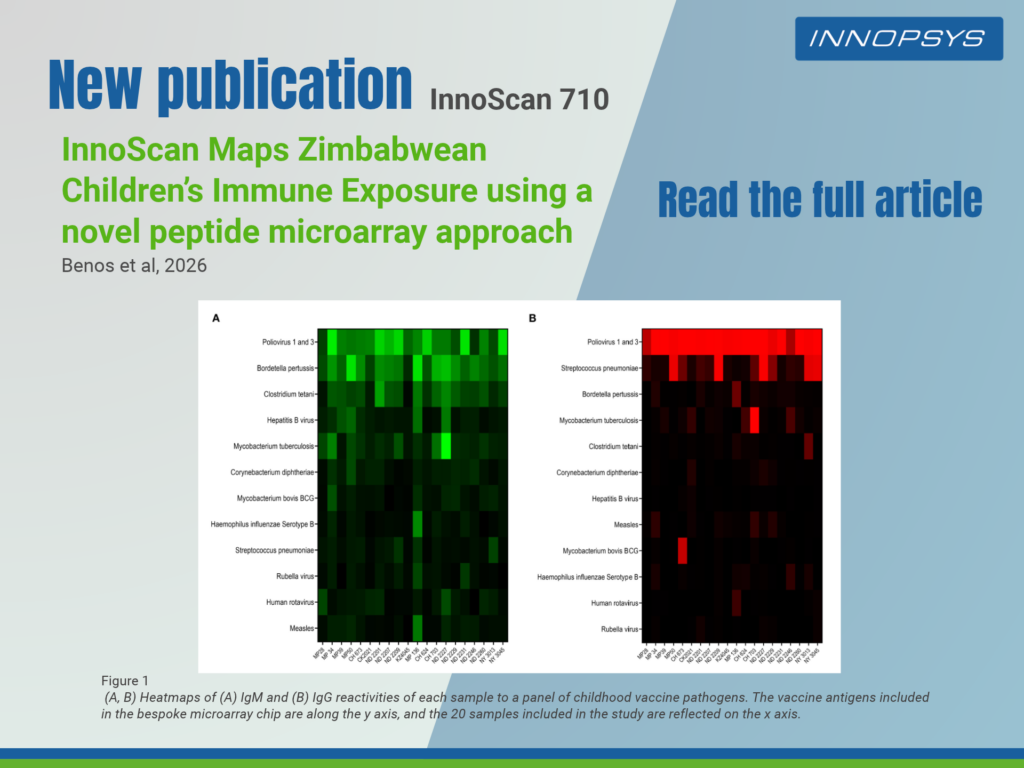
Researchers have applied a bespoke high-density peptide microarray to map the immunological exposome of Zimbabwean preschool-aged children. Using serum from 20 children under five in a schistosomiasis-endemic area, they profiled IgM and IgG against 5,614 peptides from 280 pathogens, vaccines, allergens and autoantigens. Childhood vaccine antigens with documented records served as internal validation, and the platform detected responses to all represented vaccine antigens, with sensitivities of 87.5–100% for IgM and 61.5–100% for IgG. InnoScan 710-IR infrared microarray scanner was the key readout instrument: it read microarray fluorescence, while PepSlide Analyzer performed image analysis, providing the intensity data behind these sensitivity estimates. This approach offers a powerful tool for investigating immune heterogeneity, informing vaccine development, and establishing population- specific immune reference frameworks in high-burden environments.
Original article: Mapping the exposome of Zimbabwean preschool-aged children using a novel peptide microarray approach
- Peptide microarray
- Immunological exposome
- Vaccine antigen validation
- IgM/IgG
- InnoScan 710-IR
InnoScan Maps Immune exposure