
InnoScan 710-IR microarray scanner and Mapix software: new publication
RPPA microarray powered by InnoScan
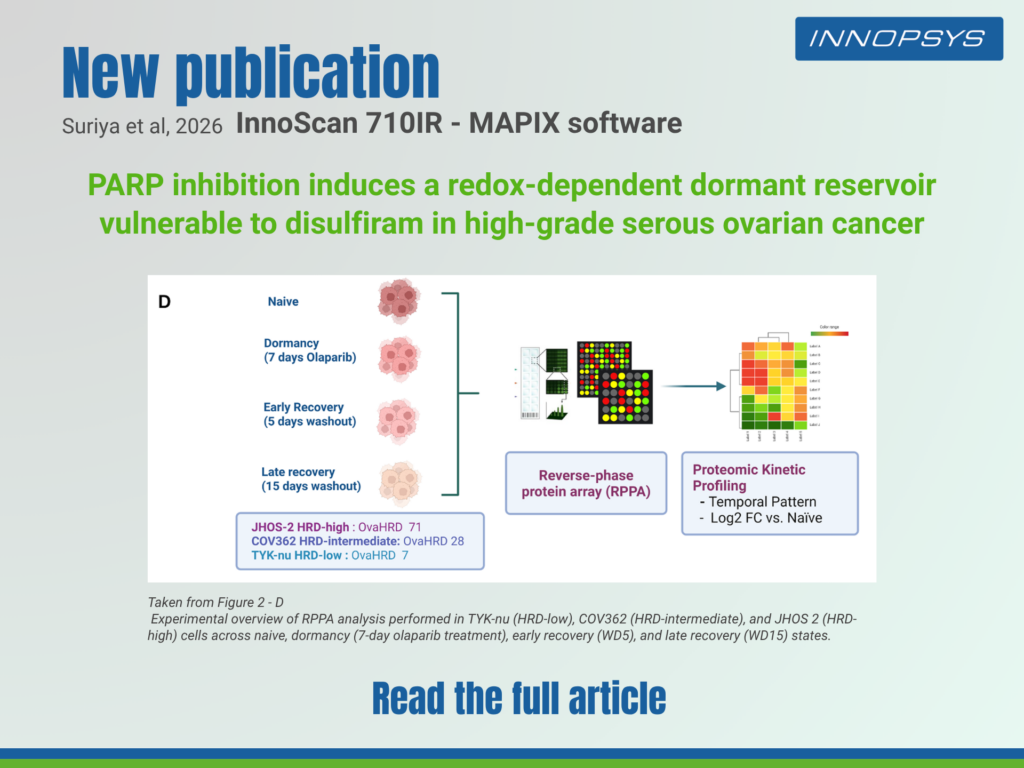
A new study in Biomedicine & Pharmacotherapy shows that PARP inhibitors can push high-grade serous ovarian cancer (HGSOC) cells into a reversible, polyploid giant cancer cell (PGCC)-enriched dormant state. Using HGSOC models, researchers found heterogeneous recovery but a conserved dependence on redox homeostasis. Reverse-phase protein array (RPPA) profiling with signals detected by the InnoScan 710-IR infrared microarray scanner and quantified by Mapix, helped map stress, growth-arrest, metabolic, and redox changes across dormancy and recovery. This identified ALDH1/2 induction as a shared adaptive feature. Disulfiram, an ALDH inhibitor, synergized with PARPi, increasing ROS and DNA damage and depleting the dormant PGCC reservoir. The combination durably suppressed clonogenic recovery and showed selectivity for HGSOC cells. InnoScan-based RPPA thus provided key proteomic evidence linking redox adaptation to a dormant residual cancer cell population that can be therapeutically targeted.
Original article: PARP inhibition induces a redox-dependent dormant reservoir vulnerable to disulfiram in high-grade serous ovarian cancer – ScienceDirect
- HGSOC
- PARP inhibitor
- dormancy
- disulfiram
- MAPIX software
RPPA microarray powered by InnoScan