
New application Note for the InnoQuant slide scanner- Alzheimer’s disease beta plaques colocalization
Mapping amyloid plaques and lysosomal alterations in 5xFAD mouse brain with InnoQuant quantitative whole-section imaging
Discover how Innopsys and the B. Benitez Laboratory, Harvard Medical School, Beth Israel Deaconess Medical Center (BIDMC), Boston have developped a workflow dedicated to the acquisition and analysis of amyloid beta plaques and lysosomal accumulation in 5xFAD mice brain model for Alzeimer’s disease study. From the fluorescence scanning of the Alzheimer’s model mice to the automated QuPath analysis pipeline, understand the hypothesis and conlusions of this work.
This application note explores the correlation between Amyloid beta plaques and lysosomal accumulation in Alzheimer’s disease.
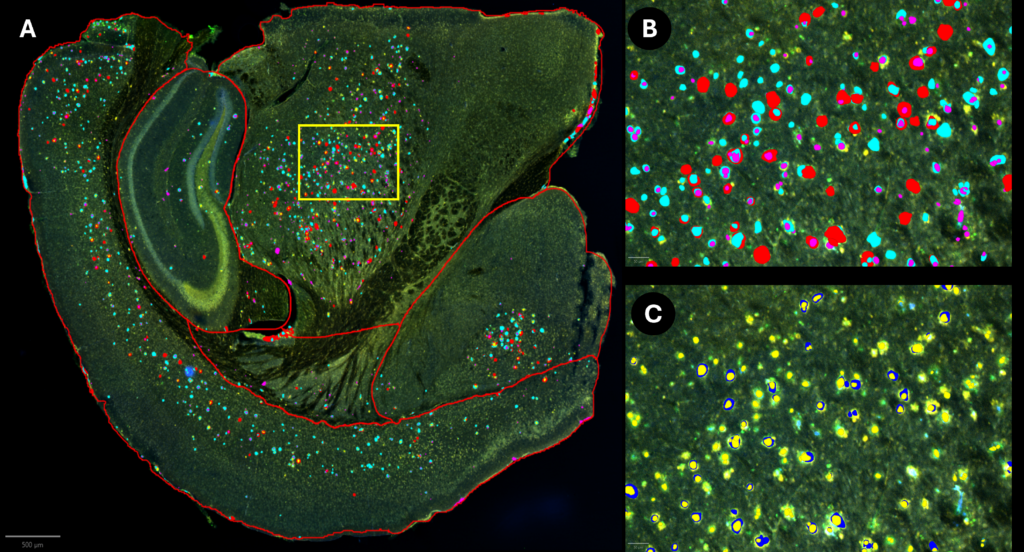
InnoQuant captured the brain sections with consistency and robustness, providing a compatible .tiff file for the QuPath analysis. The pipeline developed allows for the automatic detection of X34, 82E1 and Lamp1 signals, as well as their colocalization. The pipeline could detect object-based colocalization, based on the detection of the plaques, but also signal-based colocalization, based on the calculation of Manders and Pearson’s coefficients. This work focuses on the benefits of InnoQuant for colocalization studies, specifically about Alzheimer’s disease amyloid beta plaques and the lysosomal accumulation.

We found a strong association between amyloid beta plaque burden and lysosomal accumulation in the 5xFAD mouse Alzheimer’s disease model. Compared with WT animals, 5xFAD mice exhibited both increased amyloid deposition and a marked increase in LAMP1 immunoreactivity surrounding plaques. These findings suggest that lysosomal alterations are closely linked to the development and progression of Aβ pathology.
Innopsys is very proud to have collaborated with the presitigious Harvard medical school for this work, and we thank the Benitez Lab and everyone involved.
Read the application note on Innopsys’ website: Mapping amyloid plaques and lysosomal alterations in FAD mouse brain – Innopsys
Learn more about InnoQuant: Fluorescence slide scanner InnoQuant – Innopsys